
By Jordan Summervill

Labor Budgets Stabilize at More Moderate Levels
After peaking at 4.5%-5.0% in 2023-2024, labor budgets have normalized alongside cooling salary range movement. In 2026, most organizations are planning total labor budgets closer to 3.5%-4.0%, reflecting a return toward historical norms while still allowing flexibility to reward performance and address market or equity adjustments.
Last year, midpoint movement averaged just under 3%. Entering 2026, salary range movement softened to 2.6%, indicating a broader normalization in labor market conditions. Even with this slower pace of range movement, BalancedComp still encouraged organizations to budget approximately 4.0% for total labor increases. This approach allows employers to remain competitive while maintaining the ability to differentiate pay for top performers and make targeted salary adjustments where market or internal equity gaps persist. This projection was supported by the 2025-2026 BalancedComp Salary & Incentive Survey, which showed credit unions projected an average labor budget of 4% and banks projected 3.5%, though Banks have historically reported lower projections than the labor budgets they report the following year.
Labor Market Growth Aligns With Historical Trends
Midpoint movement was projected to be less than 3% in 2025, and proved to be 2.8% for non-exempt, 2.6% for exempt, and 2.2% for executives, with an overall average of 2.6%. Sources like World at Work, Mercer, Gallagher, and the Conference Board estimated labor budgets of 3.3-3.6%, while BalancedComp maintained a projection of 4%. It’s worth noting that most surveys also show an additional 1% for promotional increases.
Last year, wages were projected to remain elevated compared to historical norms, which helped support lower turnover. The 2024-2025 BalancedComp Survey reported turnover at 16.5%, down from 20.5% the year prior. However, in 2025-2026, turnover increased to 19%, moving closer to more typical industry-reported levels of 22%. Salary increase trends reported by the Bureau of Labor Statistics (BLS) followed a similar pattern.
In 2022 and 2023, the BLS reported average salary increases of 3.4% in the Financial Activities industry. This trend slowed in 2024, declining first to 2.9% and then to 2.1% in the third quarter. Following that low point, salary growth rebounded to 3% in the subsequent quarter and averaged 4% for 2025, reflecting a moderate recovery in financial-sector compensation.
Easing Inflation Signals Greater Economic Stability
Cost-of-living adjustments (COLAs) have fallen sharply from their 2022 peak of 8.7% to 3.2% in 2023 and 2.5% in 2024. More recently, COLA has edged up slightly to 2.8%, reflecting increases in the Consumer Price Index between the third quarter of 2024 and the third quarter of 2025. During this same period, the Federal Reserve continued to ease interest rates, lowering them to 3.64% by January 2026. Inflation averaged 2.6% in 2025, the lowest annual level since 2020, pointing to a broader return toward price stability.
These economic shifts have directly affected interest-rate-sensitive areas of financial services, particularly mortgage lending, where changes in inflation and rates continue to shape both demand and staffing needs.
Loan Departments Stabilize in 2026
Mortgage departments have faced a challenging few years, with staffing cuts driven by high home prices during the pandemic, elevated inflation, and mortgage rates that reached 7–8%. Some institutions even closed their mortgage operations entirely, outsourcing to providers like Rocket Mortgage until the market could justify the labor expense. In 2026, the environment has already improved: mortgage rates have fallen to roughly 6.0 – 6.5%, and housing market activity is showing signs of stabilization. As Lawrence Yun, NAR’s chief economist, noted,
“While 2025 remained difficult for homebuyers, the fourth quarter brought relief with lower mortgage rates and slower home price growth.”
After home prices rose just 1–2% in 2025, the market has begun to stabilize this year.
Although salary growth in mortgage departments has eased, compensation for key roles continues to rise. Positions such as Mortgage Sales Manager and Mortgage Loan Officer were among the fastest-growing title salaries last year. In 2026, banks and credit unions that focused on retaining top talent are continuing to adjust compensation, recognizing that typical commission levels are harder to achieve in the current market. Roles seeing continued higher salary increases include:
- Mortgage Loan Originator
- Head of Mortgages
- Mortgage Loan Servicer
Sustained Salary Growth in Risk, Compliance, and Audit
While labor market conditions continue to stabilize following several years of economic volatility, banks and credit unions still rely heavily on highly skilled professionals to manage the complex regulatory and risk environment unique to financial services. The ongoing, unlikely-to-change demand for specialized expertise in risk management, compliance, and audit, combined with a limited talent pool, continues to put pressure on compensation. To remain competitive and ensure strong governance, institutions are investing in these critical roles. The following risk-focused positions ranked among the 30 fastest-growing salaries in (in order):
- BSA Officer
- Director of Internal Audit
- Compliance Officer
For the past five years, the Head of Risk was among the top 30 fastest-growing salaries, but not this year. However, it is still in the top 50 moving salaries.
As the labor market cools and pandemic-related pressures ease, risk management demands in the financial sector remain high, driven by the growth of electronic banking and increasingly sophisticated cybersecurity threats. While many compliance professionals are developed internally, external market demand often outpaces internal pay growth, creating more risk than the comp-ratio may demonstrate.
Executive Compensation
In BalancedComp’s 2026 Salary Ranges, the overall executive midpoint movement averaged 2.2%, below the overall midpoint increase of 2.6%. Despite this more modest range movement, findings from the 2025–2026 BalancedComp Salary & Incentive Survey point to continued pressure on executive pay, with five executive roles ranking among the top 30 fastest-growing salaries. The following executive positions ranked among the fastest-growing salaries (in order):
- CEO/President
- Chief Operating Officer
- Head of Retail Banking
- Chief Lending Officer (2nd year in a row)
- Chief Financial Officer (2nd year in a row)
Tech Talent Remains in High Demand
Information Technology roles remain in high demand across industries, driving strong competition for recruitment and retention. Rapid advancements in technology, particularly in AI, cybersecurity, and cloud computing, continue to create a need for specialized skills. IT professionals are critical for securing systems, optimizing operations, and managing digital transformations, with expertise increasingly required in areas such as cloud-based core processors, advanced CRM platforms, and custom application development.
The rise of hybrid and remote work, combined with access to a global talent pool, has intensified the competition for top IT talent. Greater pay transparency also makes it easier for employees to benchmark their compensation against the market. Within this key support area, the following IT positions ranked among the fastest-growing salaries (in order):
- CIO/Head of IT
- IT Director
- Information Security Officer (2nd year in a row)
Other honorable mentions in IT include roles like Salesforce and CRM Administrators, which continue to see growing demand as companies rely more heavily on customer platforms. All levels of Business Analysts and Software Developers are also experiencing strong salary growth, driven by the ongoing need to improve systems, streamline processes, build new digital solutions, and determine data-driven solutions.
Evolving Conditions in the Labor Market
Since mid-May, the overall unemployment rate has remained above 4%, reaching 4.4% in December 2025. In the financial industry, unemployment had risen from 2.2% in 2023 to 2.5% in 2024, but by December 2025, the BLS reported it had declined to 2.0%, tightening the supply pool and keeping pressure on compensation levels.
Recruitment and retention remain ongoing challenges across the financial services industry, particularly as banks and credit unions compete for experienced professionals in leadership, technology, risk, and compliance roles, though conditions have stabilized compared to the height of post-pandemic disruption. Entering 2026, wage growth has moderated from earlier post-pandemic peaks for most positions but remains elevated by historical standards for in-demand and specialized roles. Remember, 4% unemployment has historically been considered full employment.
Employee job satisfaction has improved as organizations refine hybrid work models and career development pathways, yet many professionals remain receptive to new opportunities that offer advancement, skill growth, or enhanced compensation. As competition for talent persists, organizations that continue to invest in competitive pay, flexibility, and employee experience will be best positioned to attract, retain, and engage a resilient workforce in the evolving labor market.
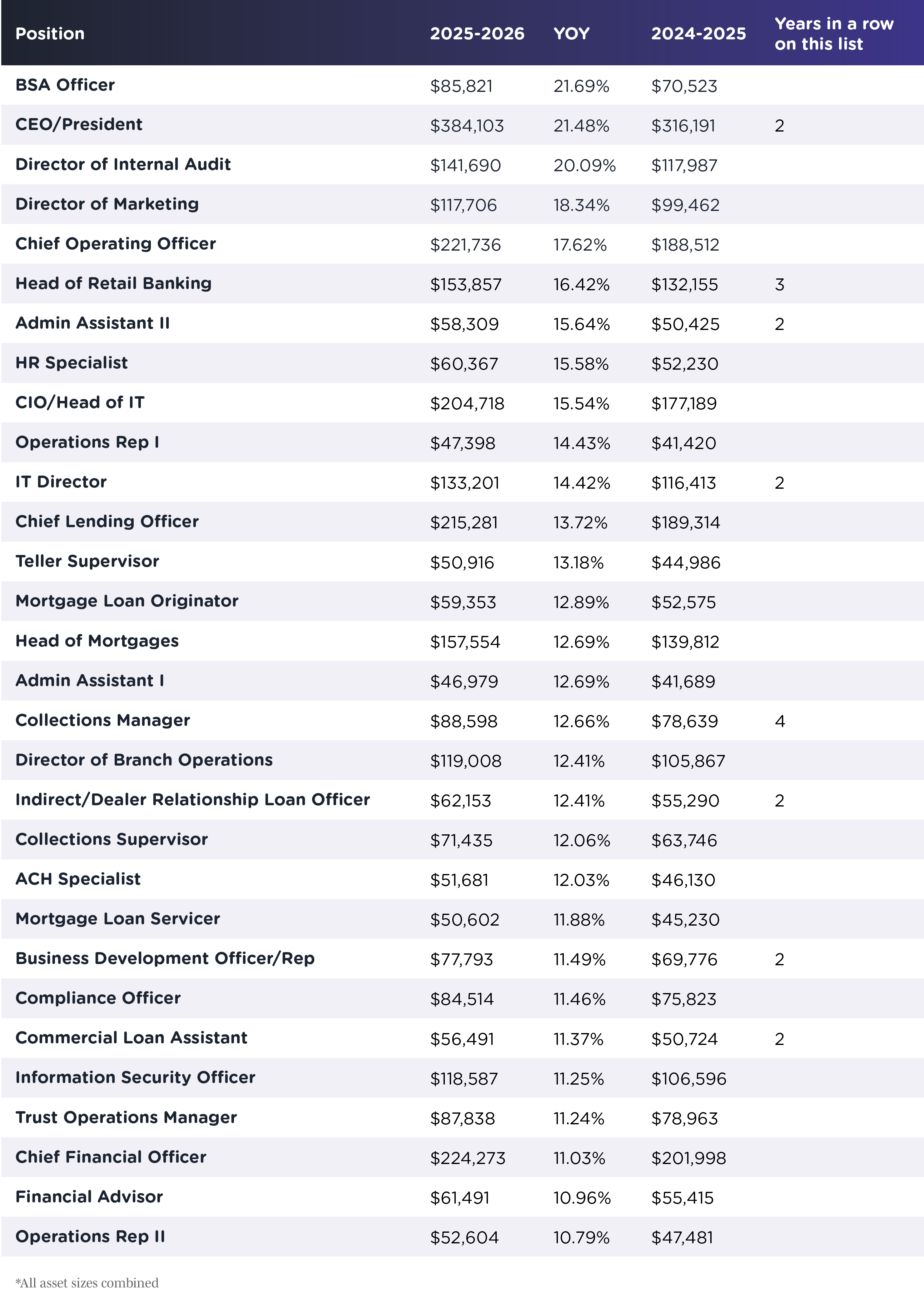
Based on our primary research, the following are the top 30 positions that have seen pay increases 150-500% faster than the average annual market rate. Interestingly, this includes some executive positions and jobs that require a high school diploma.
The 30 fastest-growing salaries by job title in the financial sector for the upcoming year, according to 2025-2026 BalancedComp Salary & Incentive Survey research data*
Back to Blog