

By Deborah Reid

As a Compensation Consultant for nearly 14 years, I’ve seen many different compensation philosophies and organizational structures. Some are more effective than others. During an implementation with a new client, the CEO shared that the company had a reputation in the community for paying low wages. As I began my meetings with the managers to evaluate the positions, I quickly learned that this organization offered a generous incentive program but paid below-market base pay. People in the community were basing their judgments on the guaranteed portion of pay.
In this case, the CEO knew the payroll expenses were much higher than those of other similarly sized companies in the same industry. Some employees were receiving large amounts of incentive pay. The company was paying out more than others, but had a reputation for not paying well.
Base pay should pay for the job; incentive pay should pay for performance.
Offering higher-than-average incentive pay may seem like the right way to motivate employees to perform at a higher level. If this is not common or typical for a specific position, it may be perceived as not competitive or “fair”, leading to difficulty in attracting new candidates. This doesn’t apply to positions like the Mortgage Loan Originator role, where the market as a whole offers both low base/high variable pay and high base/low variable pay compensation structures. It has been shown that those with a high variable-pay/low base-compensation strategy do, indeed, achieve higher loan production on average. But that doesn’t translate well to all positions where the ideal employee profile is not that of a risk-taker. An example of this concept is the Teller role, where the average annual incentive may be 4-5%, depending on asset size. If you double that and pay 8-10% of base pay in incentives, do you think your tellers will refer more often, balance their drawer more accurately, or have fewer posting errors?
Higher Incentive Pay
Pros:
- Drives performance: Employees have a direct financial reason to achieve defined goals.
- Aligns employees with organizational results: The company pays more when the desired results are achieved.
- Rewards high performers: Strong performers have greater earning potential.
- Controls fixed costs: More compensation is variable rather than permanently increasing payroll.
- Works well for measurable roles: Especially effective in sales, business development, production, and other positions with quantifiable results.
Cons:
- Creates income uncertainty: Employees may dislike having too much of their income dependent on business or individual performance.
- Can encourage short-term thinking: Employees may focus on hitting the incentive target rather than long-term organizational success.
- Can create competition instead of collaboration: Poorly designed incentives can encourage employees to protect their own results rather than help the team.
- Requires strong plan design: Goals must be achievable, measurable, understandable, and within the employee’s ability to influence.
- Not appropriate for every position: It can be difficult to establish meaningful individual metrics for administrative, support, or certain leadership roles.
Especially with new pay transparency laws in place, companies may be forced to share the base pay range with potential candidates. Since incentive pay is not as easy to predict for each employee, base pay needs to be competitive within the market.
Building a salary administration program that allows you to evaluate each position to determine market-based base and incentive levels is key to using a structured methodology that considers job responsibilities, complexity, scope, and required skills. It’s also key to use reliable market data tailored to the organization’s industry, size, geography, and talent market.
One mistake I see organizations make is thinking:
“If we want better performance, we need more incentive pay.”
Not necessarily.
For many positions, employees have limited ability to influence organizational financial results. In those cases, a strong base-pay structure, performance management, and merit increases can be much more effective.
I would ask:
“Can the employee reasonably control the outcome we’re paying them for?”
If the answer is no, incentive pay probably shouldn’t be a major part of their compensation. One thing HR can do to help executives see the futility of this approach is to examine the profile of a good performer in the role. If the answer is an eye for detail, that person is likely not motivated by incentive pay. You are better off paying at the higher end of the range and managing for performance.
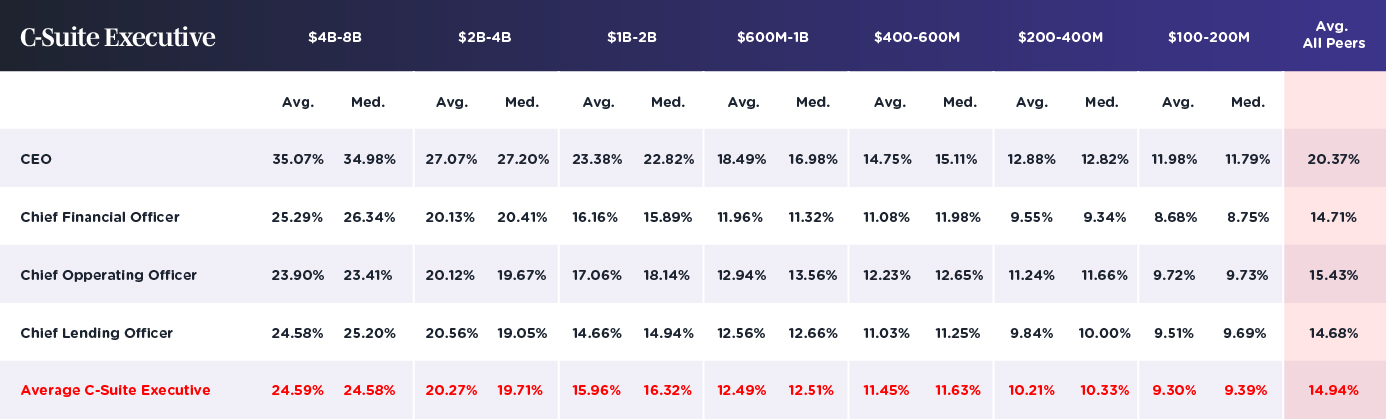
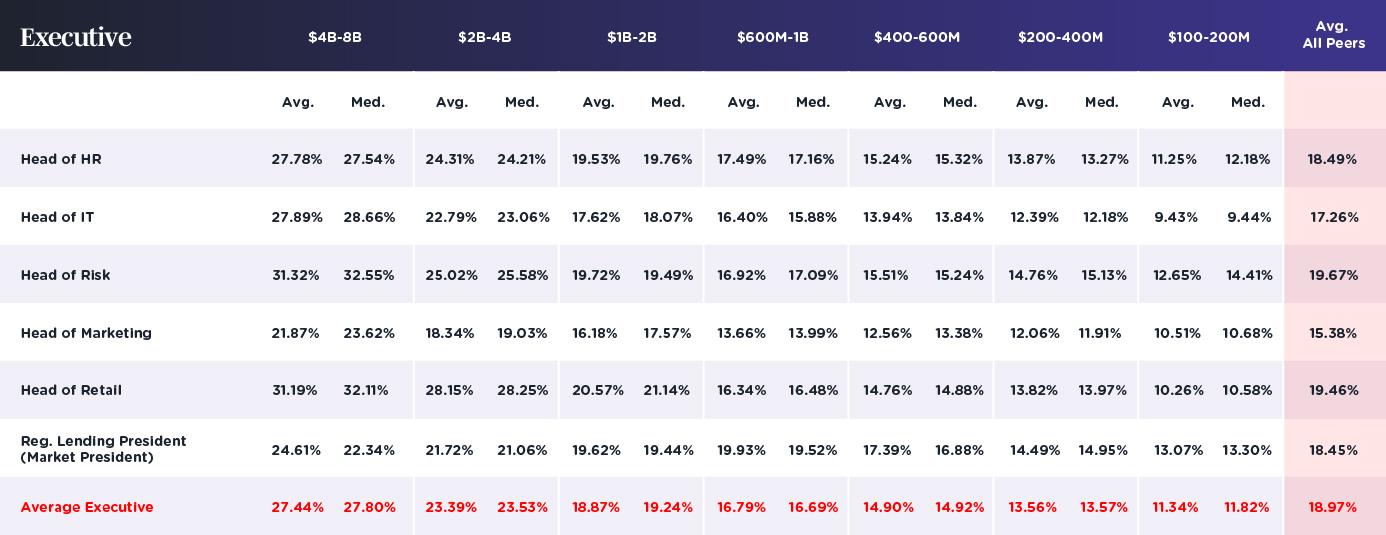
Below is a list of average incentive pay for executive and C-suite roles to help you evaluate if you are paying equitably to market on incentives. Please reach out if you have questions about the average incentive amount paid in an asset category for an exempt or non-exempt role.
Back to Blog